Open Access Academic Publisher•
NG-JOURNAL-OF-LIBRARIANSHIPNJLOpen Access (CC BY 4.0)

NextGen Journal of Librarianship

The NextGen Journal of Librarianship is a peer-reviewed, open-access scholarly journal dedicated to advancing research, innovation, and professional practice in librarianship, library and information science, knowledge management, and digital information services. The journal provides an international platform for researchers, librarians, information professionals, educators, and technology practitioners to share original research, theoretical contributions, systematic reviews, and practical insights addressing the evolving role of libraries in the digital age. Aims and Scope The journal welcomes original contributions in areas including: Library and Information Science Digital Libraries and Institutional Repositories Information Organization, Cataloguing, and Classification Knowledge Management and Information Retrieval .Artificial Intelligence and Automation in Libraries Digital Preservation and Electronic Records Management Academic Libraries and Research Support Services Public, School, and Special Libraries Information Literacy and Digital Literacy Bibliometrics, Scientometrics, and Research Evaluation Open Access, Scholarly Communication, and Publishing Library Management, Leadership, and Policy Data Management and Research Data Services Emerging Technologies in Information Services User Experience, Information Behaviour, and Library Services

Print ISSN: N/A•Online ISSN: 3156-6651
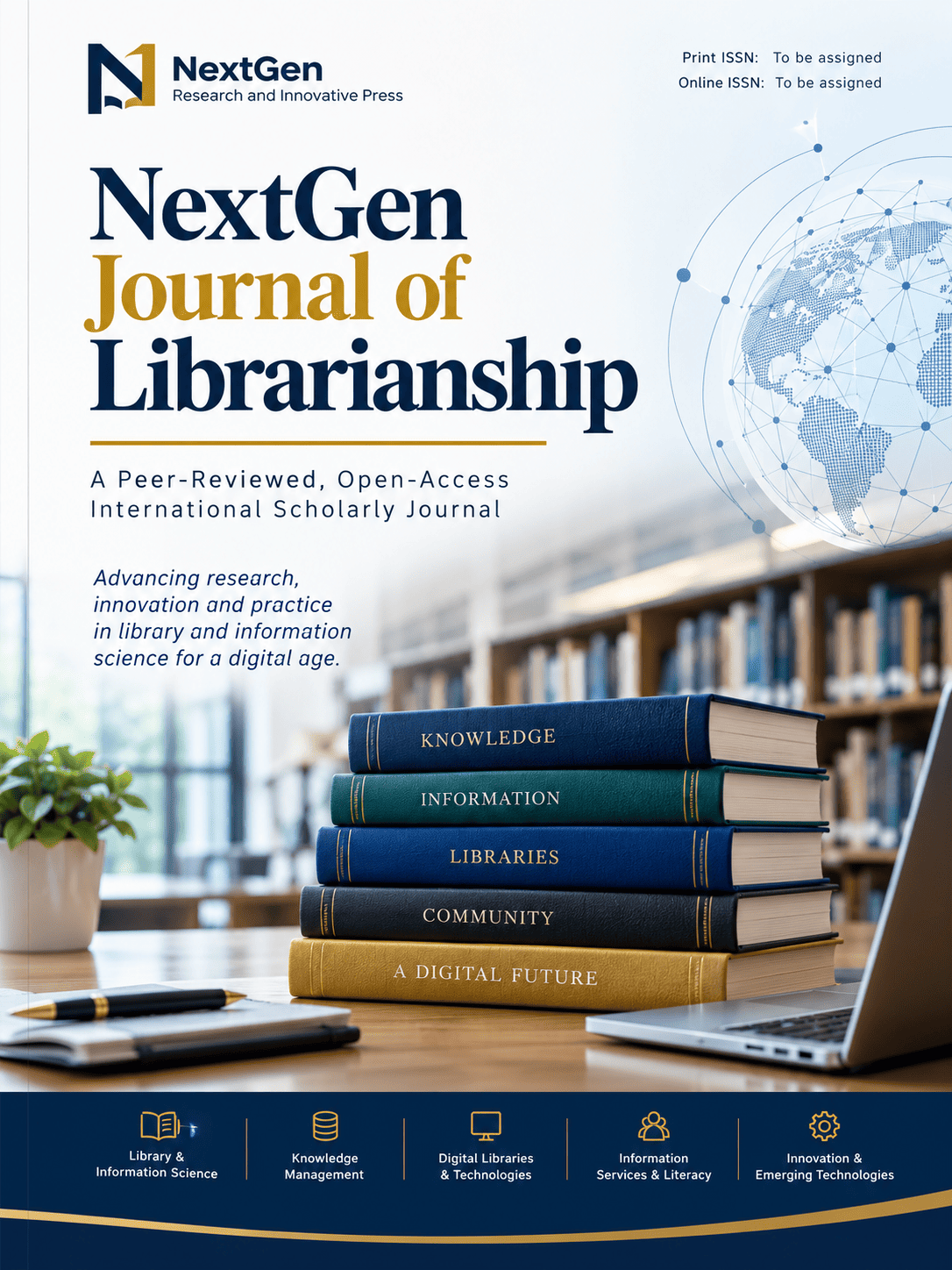
NextGen Journal of Librarianship cover

About the Journal & Aims & Scope

About NextGen Journal of Librarianship

NextGen Journal of Librarianship is a peer-review scholarly journal aimed at encouraging Library and Information Science Educators, Academic Librarians, Researchers, Lecturers and Postgraduates toward conducting empirical and conceptual research in the fields of Library and Information Science, Digital Scholarship, Information and Knowledge Management, Information and Communication Technologies, Information Resource Management, Archives and Records Management, Education Technologies, and other related fields. It is published Quarterly (March, June, September and December).

Open Access Mandate

All articles published in NextGen Journal of Librarianship are made permanently and freely accessible online immediately upon publication under the terms of the Creative Commons Attribution 4.0 International License (CC BY 4.0). Authors retain full copyright of their intellectual output.

Peer Review and Archiving

We employ a strict double-anonymous peer review protocol to guarantee objective, merit-based evaluations. All published manuscripts receive a Crossref Digital Object Identifier (DOI) and are digitally preserved across institutional and global scholarly indexing networks including Google Scholar.

Notice to Contributors

NextGen Journal of Librarianship is based on double blind peer review process, whereby any article(s) submitted for publishing is reviewed by two anonymous reviewers. The comments of the reviewers shall be sent to the author(s) for necessary action. Revisions are reviewed by the editors to determine if the revision adequately deals with the concerns of the reviewers regarding the initial draft. Reviewers are experts in their fields and are sourced globally by the editorial committee. The Editorial Board has responsibility for all final decisions regarding manuscripts and the review process. Opinion expressed in articles published in this Journal are those of authors. Materials appearing in the Journal must not be reprinted in whole or in part without permission in writing. Contributors are liable for any article that has been published elsewhere. Authors carry their full responsibility themselves regarding the opinions of their articles. The Journal is requesting authors to submit well researched manuscripts for assessment and possible publishing. Authors are to note that their manuscripts would be subjected to plagiarism checks before acceptance. Submissions must be original, not yet published and not submitted to or under review by any journal or publication body.

Guidelines to Authors

In the preparation of the manuscripts, the following conditions must be adhered to:

1) Manuscripts should be typed on A4 paper using 12-point font size in double line spacing. The manuscripts should not exceed 15 pages, figures and tables’ inclusive extra pages and photographs will attract additional charges.

2) Title and abstract must be on the first page. The paper title, author(s) name(s) and address should be bolded and centred.

3) Abstract should not exceed 250 words and must be written in italics style. It should be instructive and structural about the paper.

4) A brief introduction of the work or write-up is needed and should contain, aim of the work or write-up, review of relevant literature, contribution to knowledge and problems encountered.

5) The latest American Psychological Association (APA), 7th edition style of referencing method will be highly preferred.

6) For presentation of figures and tables, line drawings are prepared and the figures and tables numbering should be in Arabic numerical.

7) The manuscripts will be sent to the author(s) after assessment for correction

8) After the correction of the reviewed manuscript, both the reviewed manuscript and corrected copies should be sent back to the editor.

9) For an accepted manuscript, it is assumed that authors have surrendered copyright of the manuscripts to the journal

10) Any manuscripts published or accepted for publication in another journal will not be accepted.

11) Manuscripts are to be submitted in softcopies through the following email address:

12) Authors are expected to pay the sum of N5,000 non-refundable assessment fee.

13) After acceptance of manuscripts, authors will be required to pay the sum of N25,000 non-refundable fee before their papers are published.

14) Authors must avoid any form of plagiaris

Notice to Advertisers:

Request for more information on advertisement rates via

The Secretariat, Editorial Board,

Subscription:

All manuscripts, correspondence, issues on editorial matters and subscription information should be addressed to: nextgenjournals@gmail.com

CURRENT ISSUEVol. 1, No. 1 (2026)

Inaugural Issue: Advances in NJL

Premier issue featuring foundational peer-reviewed research and methodologies.

Published Research

1 Articles
10/18/2026DOI: 10.5555/necr.2026.003

Management and Embedded Librarians -Faculty Collaboration in the AI Age: Insights from Nigerian Universities

Lucky Oghenetega URHIEWHU, Uche Mokobia

This study investigates the strategic role of university management in fostering collaboration between embedded librarians and faculty staff to enhance accreditation outcomes in Nigerian universities. With the growing emphasis on digital infrastructure and quality assurance, embedded librarianship—where librarians integrate directly into academic departments—has emerged as a vital approach to supporting teaching, research, and curriculum development. Despite its potential, integration remains limited due to institutional barriers, inadequate policy frameworks, and insufficient managerial support. Using an exploratory descriptive survey design, data were collected from 65 librarians across Nigerian universities through stratified random sampling, supported by faculty questionnaires and in-depth interviews with university management. Quantitative data were analyzed using descriptive statistics and inferential tests, while qualitative responses were thematically examined. Findings reveal that Embedded Librarians significantly contribute to accreditation processes by preparing documentation, ensuring collection standards, and collaborating with faculty. Management support, particularly through resource allocation and structured interaction, was moderately perceived. However, significant challenges—including poor funding, lack of training, weak institutional policies, and regional gender disparities—continue to undermine collaboration. Communication is primarily through Whatsapp/Institutional Email, with limited use of online collaborative platforms, suggesting a gap in digital integration. The study concludes that while embedded librarianship holds promise for strengthening institutional accreditation, its success hinges on proactive managerial strategies, digital infrastructure investment, and continuous professional development. It recommends that universities implement policy reforms, promote gender equity, and enhance digital literacy to maximize the strategic contribution of librarians in quality assurance and accreditation success.

Citation Metrics

JCR 2025
4.00
2-Yr Impact Factor
4.60
5-Yr Impact Factor
CiteScore™ Tracker4.90
Google Scholar Indexed Active
Crossref DOI Prefix10.5555/ng-journal-of-librarianship

Indexed globally across Google Scholar, Crossref, and OpenAlex with full Highwire Press meta citation tags. Click the masthead badge for the complete calculation report.

Editorial Board

View All →
  • Dr Lucky Oghenetega Urhiewhu
    Editor-in-Chief
    Dennis Osadebay University Asaba Delta State
  • Professor David McMenemy
    Senior Associate Editor
    University Gardens, Glasgow, G12 8QH, United Kingdom
  • Prof. Ifeka E. Okeke
    Associate Editor
    Department of Library and Information Science, Nnamdi Azikiwe University, Niferia
  • Dr Jessica Bates
    Associate Editor
    Ulster University United Kingdom

Issue Archive

All Volumes →

Browse previously published issues, special thematic collections, and complete issue tables of contents.

Journal Information

PublisherNextGen Innovation & Research Journals
Peer Review PolicyRigorous double-anonymous peer review conducted by independent domain experts. Minimum two review reports required prior to editorial decision.
Article Processing ChargesAll article processing charges (APCs) are fully sponsored by NextGen Press Foundation for the current publishing year.
Editorial Office Inquirieslucky.urhiewhu@dou.edu.ngEditor-in-Chief: Dr Lucky Oghenetega Urhiewhu